Got a signwritten ute in the yard that you've never paid a cent of FBT on? That's about to change.
From 1 April 2027, the rules for fringe benefit tax (FBT) on work vehicles are getting a big shake-up. The good news - less paperwork, and no more logbooks for most vehicles. The not-so-good news - the exemption that's kept lots of work utes and vans FBT-free is on its way out.
Here's what's happening, in plain English, and what it could mean for you.
When is this happening?
The changes are in a tax bill that went to Parliament on 10 September 2026. It's now with a select committee, which is asking for public submissions by 1 December 2026.
It's not law yet. The election has slowed things down a little, and some details could still change. But these changes have been well signalled, so we'd plan on 1 April 2027.
One date already matters. If you've bought or leased a vehicle since 10 September 2026, it may need signwriting to get the lower FBT rates (more on that below). Vehicles you already had are fine.
So what's actually changing?
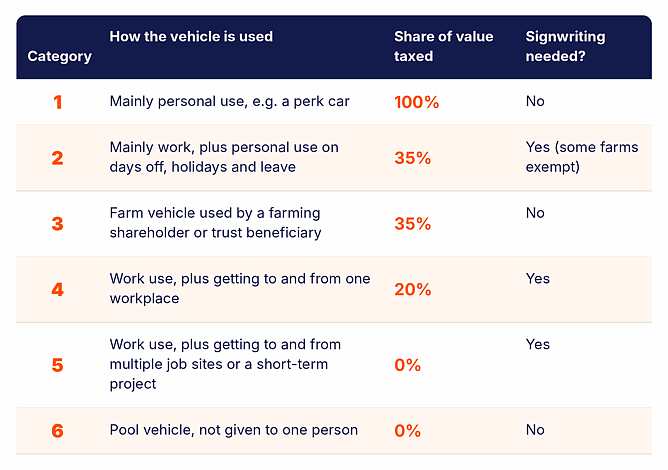
Every vehicle gets a category. Instead of tracking every day a vehicle was available for private use, you'll pick one of six categories based on how it's used. You only revisit it if that use changes. And no - stopping for milk on the way home doesn't count.
The work ute exemption is going. Right now, a signwritten ute or van that's only used to get to and from work can be FBT-free. From April 2027, that's gone.
EVs and hybrids get a better deal. The yearly rate stays at 20% of cost for petrol and diesel, but drops to 19.6% for hybrids and 17% for EVs.
Small companies get an easier option. If your company has two vehicles or fewer, you may be able to split the costs between business and personal use instead of paying FBT (some conditions apply).
What could this look like for you?
We've kept these examples simple. They're based on vehicle cost and the 63.93% single FBT rate, and show yearly FBT rounded to the nearest dollar.
The tradie with the signwritten ute
Mike's electrical business has a $65,000 diesel ute with the logo down the side. His apprentice takes it home each night, and right now there's no FBT on it. From April 2027, it depends on how it's used:
• Home to the yard and back only - about $1,662 a year
• Also used on weekends and days off - about $2,909 a year
• Straight from home to different job sites - nil
Same ute, very different bills.
The family farm
Aroha and Tom farm through their company. Aroha's $60,000 ute is mostly used on the farm, with some personal use when she's off the clock - about $2,685 a year. Their workers' utes go in Category 2, and because it's a family farm, no signwriting is needed. The ute that stays on the farm for anyone to use? No FBT at all.
The office with an EV
A local firm gives a senior team member a $60,000 EV for client visits and getting to the office. With the firm's logo on it, that's Category 4 - about $1,304 a year. If the car is available for private use every day under today's rules, it could be costing around $7,672 a year now. That's a nice saving! And an unbranded pool EV kept at the office is FBT-free.
The owner-operator with one company car
Sarah runs a small design company that owns one $50,000 car she uses for work and personal trips. Instead of paying FBT, her company could choose to claim just the business share of the running costs. For lots of owner-operators that's simpler and cheaper - but you'll still need a logbook to back up the business percentage.
What should you do now?
Don't panic - there's still time. But it's worth getting ahead of it:
• List your vehicles - who drives them and how they're used
• Check which ones are FBT-free today - these are the ones most likely to change
• Look at your vehicle policies - do your rules on personal use match the category you want?
• Check signwriting on anything bought or leased since 10 September 2026
• Think before you buy - an EV, hybrid or pool vehicle could cut your FBT
Let's chat
Not sure where your vehicles will land? Come have a chat with us at Varntige. We'll help you work through your vehicles and plan for April 2027, so there are no surprises.
This is general information, not tax advice. The rules could still change before they become law.